Thursday, 9 August 2012

Light & colour in Saint Cézaire, South of France

I have been away from here for a while as I have been in the South of France for a few weeks. I've been relaxing, enjoying the sunshine, absorbing some French culture & inspiration (all of this without internet access!)
One beautiful day, we drove up to the small town of Saint Cézaire. The sun rose high into the sky scorching the roofs, roads & surrounding countryside.


The water bubbled lazily from the fountain in the town square, as we took refuge from the midday sun close by in the shady pizzeria.


Later we visited this brocante, the French equivalent of a flea market. Often these markets take place on a particular day & sprawl through the streets of a town. This brocante was a single shop, but it had still managed to escape out the door & spread itself across the pavement! It offered many strange & wondrous objects for sale, including ancient door handles. We bought two pairs, one brass and, the other, porcelain & for only 10€ each. They are now installed & look perfect in our English Victorian house.


I love the creamy colours against the amazingly, blue sky & the play of the angles of the buildings & the curve of the road.

P.S. I have to admit to feeling rather pleased that I discovered how to type French accents & the Euro symbol on a UK keyboard!

Tuesday, 26 June 2012

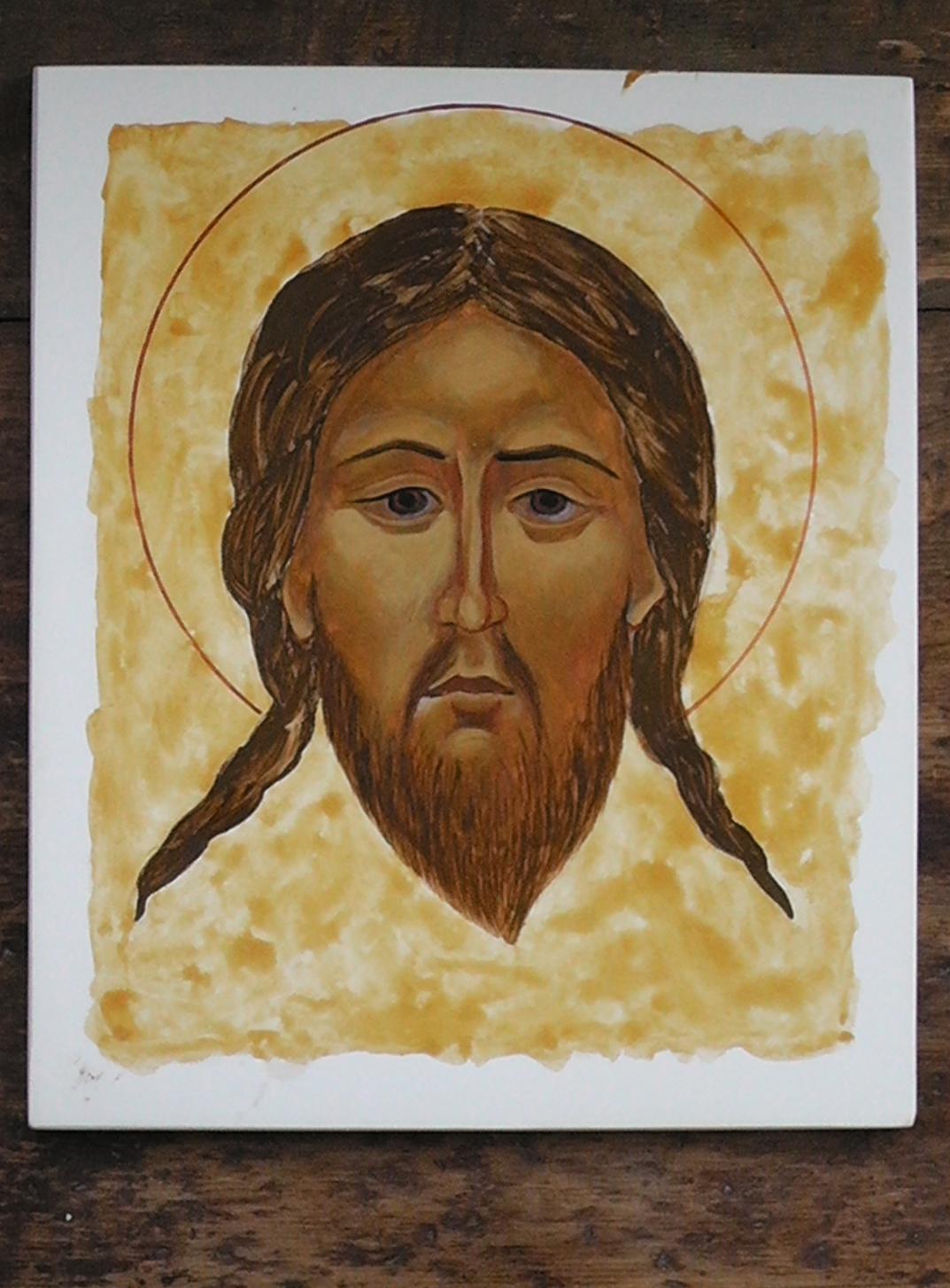
The (almost) finished icon

Saturday was the second part of the icon workshop, tutored by Ian Knowles. As this was only a two day workshop and not long enough to complete an icon from scratch, the face was marked out from a template using red ochre powder. Each person then made the egg tempera paint from egg emulsion & ground pigment. The focus was on rendering the image by building up layers of tone & colour.
Here is the painting of the first few layers that I completed last week:


Below are the subsequent stages as the face began to emerge.


These are the group's finished icons (mine's the one in the centre). I found it fascinating how they all began from the same few inital markings and yet, seemed to have developed their own expressions & individuality.


For anyone who missed it before, here is the link to Ian's website, Elias Icons, where his beautiful work can be seen.

Thursday, 21 June 2012

The Holy Face

As a spiritual, rather than a religious person, I approach the subject of icons from an artistic perspective & I am drawn to their beauty. On Saturday, I attended the first part of a two week workshop to paint an icon using egg tempera.

It was the end of an exhausting week at work & I really didn't relish the thought of having to get up on Saturday at the same hour I would during the week - but it was certainly worth the effort.The workshop was tutored by iconographer, Ian Knowles,

In addition to the icons, the other aspect of this course that interested me was that we would be making our own paints. Regular readers of this blog will know that this is something I have tried before & the account of my previous attempts at this can be viewed here. I'm pleased to report that the results were much more successful this time. With support from Ian, we made our own egg tempera, a magical blend of egg, vodka & raw pigment. I have to admit that, for me, the vodka was a surprise ingredient!

Once the paint was mixed, the painting process began.....
Below is the icon so far. It already has 5 layers of tempera on the face, although the background will remain as it is, covered with one layer of variegated wash. The face is built up progressively, working from dark to light - it's fascinating seeing it gradually appear.


I am very excited about Saturday's workshop & shall be out of bed before the alarm this week! I promise to report back with an update.

Please take a look at Ian's exquisite work, which can be viewed at Elias Icons

Tuesday, 12 June 2012

A very small museum

I have a confession to make, I have a really unappealing habit, I'm trying to control it, but a lot of the time it gets the better of me.
This is my problem- I see things on the ground & have an uncontrollable urge to pick them up...
Sometimes they're beautiful natural objects, leaf skeletons, a soft shaped piece of turquoise glass smoothed by the ocean or a newly escaped polished conker.  Occasionally, the 'treasures' are not what they first appear & are hastily dropped to the ground again. My pockets are full of these impulse acquisitions, which often crumble to nothing before reaching my studio. For those that do survive the hazardous journey, superior accommodation awaits.

After a visit to the Natural History Museum in Oxford, I had this idea that I wanted to have a museum of my very own. My other favourite museum in Oxford is the Pitt Rivers Museum. One of the reasons that I love it so much is the eccentric classification system; exhibits are grouped by type, rather than the usual way, by geographical or cultural area

However, my museum is much smaller, being housed in a couple of glass lidded tea boxes that I purchased specially for this purpose. I have, however, contrived my own classification system.


The Pitt Rivers Museum has heavy drawers that can be pulled open by their brass handles to reveal hidden treasures. Some of these items are not that pleasant; I am thinking here of the 'sympathic magic' section. One item is a bull's heart, pierced with iron nails & found in a chimney in the New Forest, Dorset. None of my treasures are, thankfully, quite as nasty as that.


What links these objects, that they are similar shapes, natural objects or similar colours? I think it's nearly all of these things and yet, not quite any of them. 
I have lined the compartments with scrunched up tissue paper & plan to make a label for each, written in scratchy handwriting, detailing the contents.


List of contents left to right.
Top row: Bees extracted from the dining room chimney which contained a nest, coral gifted by an elderly relative, an unindentified fruit (collected from a path in a French forest)
Middle row: Ammonite bought from Natural History museum, Oxford, devil's toenail I dug up in my garden, black beetle, honey bee & section of exquisitely coloured butterfly wing
Bottom row: Owl feather (down) found on a walk by the river Severn,  piece of broken pink pressed glass dessert bowl (echoing the shape of the ammonite), foil wrapper that once held a chocolate ammonite, which my daughter gave me as a present from Lyme Regis.

N.B. No creatures were harmed in the assemblage of this museum


Monday, 28 May 2012

Iris & transience

I wait all year for these irises to appear. I brought them from my late parents' garden. Their joint enterprise; my father grew them & then, my mother would paint them.
Each May, I take many photos, but it's never the same as drawing or painting from real life. Yesterday, I grasped the moment, sat in the sunshine & recorded their beauty as best I could.

This morning they were gone, their remains like shrivelled, wilted paper left on the stem.


Tuesday, 22 May 2012

Leonardo at Bristol

There are not many displays of under a dozen exhibits that I would drive over 40 miles to see, but I made an exception for the latest exhibition at Bristol Museum & Art Gallery.
On show until 10th June, 'Ten Drawings by Leonardo da Vinci' is the main attraction & for good reason.

This exhibition, although light on exhibits, contains examples of all of Leonardo's major areas of work. He thought of himself as a scientist first & an artist second. Two of the examples are meticulous anatomical drawings, one of arms & the other of bones of the foot. Others include designs for clothing & sculpture.


I loved this drawing of Leda (below) & was fascinated by the techniques used. Leonardo had made an under drawing of black chalk & then a fine drawing of ink was made on top of this. It was amazing to see the marks made by his hand over 500 years ago.


This was my personal favourite, Scenes from the End of the World. Click on the photo to see clouds raining fire & skeletons rising up from the ground- an interesting subject for the leading scientist of the age!


I came away inspired to find out more about Leonardo & become more prolific as an artist!

 The drawings are part of the Royal Collection & are being exhibited as a Diamond Jubilee Celebration.

Monday, 14 May 2012

Light & the Great British Seaside


Summer is getting off to a slow start here in the UK. However, yesterday & today have been full of sharp, bright light & searing blue skies that, whilst there's still a nip in the air, whisper the promise of hot summer days to come.

I'm currently teaching an online drawing class & as part of the preparation, wanted to take some photographs of pebbles. I already have pebbles in my garden collected on previous excursions to the coast, but what I didn't have was the right type of light.


I decided that I owed it to my students to give them photographs of pebbles taken in situ on a beach in coastal light.  The nearest place, I could get to easily, was Clevedon on the south west coast. Technically speaking, Clevedon is at that point where river & ocean meet. The water contains silt washed down the river by recent heavy rain, & yet, it's tidal, has small pebbled beaches & a beautiful Victorian pier.


On the drive there, I was thinking about the fact that artists seem to be drawn to the light of the western coast & why this should be. For example, the St Ives artists in Cornwall & St David's in Wales is also a congregating point for artists. Is this just true in Britain or does this happen in other places too, artists creating communities to take advantage of the western light. Do you know of any others?